
Fue el pasado mes de mayo cuando decidí visitar el Museo Andrés Segovia de Linares (Jaen), con la intención de estudiar alguna de las guitarras que pertenecieron al Maestro.
Alberto López (Director del museo e hijo de Alberto López Poveda, biógrafo de Andrés Segovia) me permitió estudiar una Hauser del año 1950.
Quiero destacar el buen trabajo que realiza este museo, a parte de guitarras históricas y objetos personales, toda la información relativa al maestro Segovia, su vida y obra, se puede encontrar aquí. Y también agradecer la disponibilidad a permitirme examinar esta guitarra.
Quiero destacar el buen trabajo que realiza este museo, a parte de guitarras históricas y objetos personales, toda la información relativa al maestro Segovia, su vida y obra, se puede encontrar aquí. Y también agradecer la disponibilidad a permitirme examinar esta guitarra.
It was in last May when I decided to visit de Andrés Segovia Museum in Linares (Jaen), with the intention of studying some of the guitars that belonged to the Master.
Alberto López (Director of the museum and son of Alberto López Poveda, the biographer of Segovia) allowed me to study a Hauser of the year 1950
I want to highlight the good work that this museum does, apart from historical guitars and personal objects, all the information related to the master Segovia, his life and work, can be found here. And aso thank you for the abailability to allow me to examine this guitar.
I want to highlight the good work that this museum does, apart from historical guitars and personal objects, all the information related to the master Segovia, his life and work, can be found here. And aso thank you for the abailability to allow me to examine this guitar.


 |
Foto arriba; parte del panel informativo expuesto en el patio interior del museo, donde se citan todas las guitarras usadas por A. Segovia. Información obtenida de la biografía de Andrés Segovia escrita por Alberto López Poveda. El texto menciona la guitarra Hauser 1950 y los tipos de maderas usadas en su construcción.
Photo above; part of the information panel exposed in the inner courtyard of the museum, where all the guitars used by Segovia are cited. Information obtained from Andrés Segovia´s biography, written by Alberto López Poveda. The text mentions the 1950 Hauser guitar and the types of wood used in its construction
La guitarra estaba guardada en el archivo, no estaba expuesta en las vitrinas porque tiene una grieta en el fondo.
Pronto empecé a darme cuenta de la importancia de esta guitarra gracias a la gran cantidad de información discográfica y literatura existente en el museo, y también gracias a la ayuda de personas que me mandaron información.
Se trata de una Hauser I, una de las últimas guitarras que Hermann Hauser construyó en su taller de Reisbach antes de morir, y que fue especialmente construida para Andrés Segovia.
The guitar was stored in the museum archive, it was not exposed in the showcases becouse it has a crack in the back.
Soon I began to realize the importance of this guitar thanks to the large amount of record information and literature in the museum, and also thanks to the help of people who sent me information.
It is a Hauser I, one of the last guitars that Hermann Hauser built in his workshop in Reisbach before he died, and it was specially made for Andrés Segovia.

En la foto de arriba (Andrés Segovia tocando), se aprecian importantes detalles sobre la roseta, la etiqueta y las reparaciones interiores de la guitarra, que prueban claramente que se trata de la misma guitarra que estoy estudiando en el Museo de Linares.
Foto aportada por el informante John Saldivar (Guitarrista de Austin, Texas. Experto en la vida y obra de Andrés Segovia y en guitarras históricas), quien a su vez afirma que esta foto apareció en una caja de cuatro discos, publicados con motivo del centenario del nacimiento del Maestro Segovia, y también en el Segovia´s Golden Jubilee (3LP), ya que esta guitarra fue la más conocida en los retratos de esa
época, 1950 en adelante. Tanto la foto como los discos mencionados se pueden ver en el museo
In the photo above, (Andrés Segovia playing), one can see important signs as the rosette, the label and the internal repairs of the guitar, that evidences that it is the same guitar that I am studying in the Museum of Linares.
Photo provided by the informant John Saldivar (Guitarist from Austin, Texas. Expert in Andrés Segovia´s life and work and in historical guitars), who in turn states that the photo appeared in a box with four disc records, published on the ocasion of the centenary of Master Segovia´s birth, and also in the Segovia´s Golden Jubilee (3LP), since this guitar was the most known in pictures of that time, 1950 onwards.
Both the photo and the records can be seen in the museum.

Arriba, foto de Segovia practicando música de Villa Lobos en su apartamento de Nueva York con esta guitarra. (Información, aportada por John Saldivar)
Photo above, Segovia rehearsing Villa Lobos, at his apartment in New York, with this guitar. (Information, provided by John Saldivar)

Foto tomada por mi amigo e informante Richard Arellano Páez (Guitarrista y luthier de Caracas, Venezuela), sosteniendo uno de sus discos de Segovia donde aparece el maestro con esta guitarra. Este disco también se encuentra en el museo.
Above, picture from my friend and also informant, Richard Arellano Páez (Guitarist and luthier from Caracas, Venezuela), holding one of his Segovia´s album, where the Master appears with this guitar. This album is also in the museum.
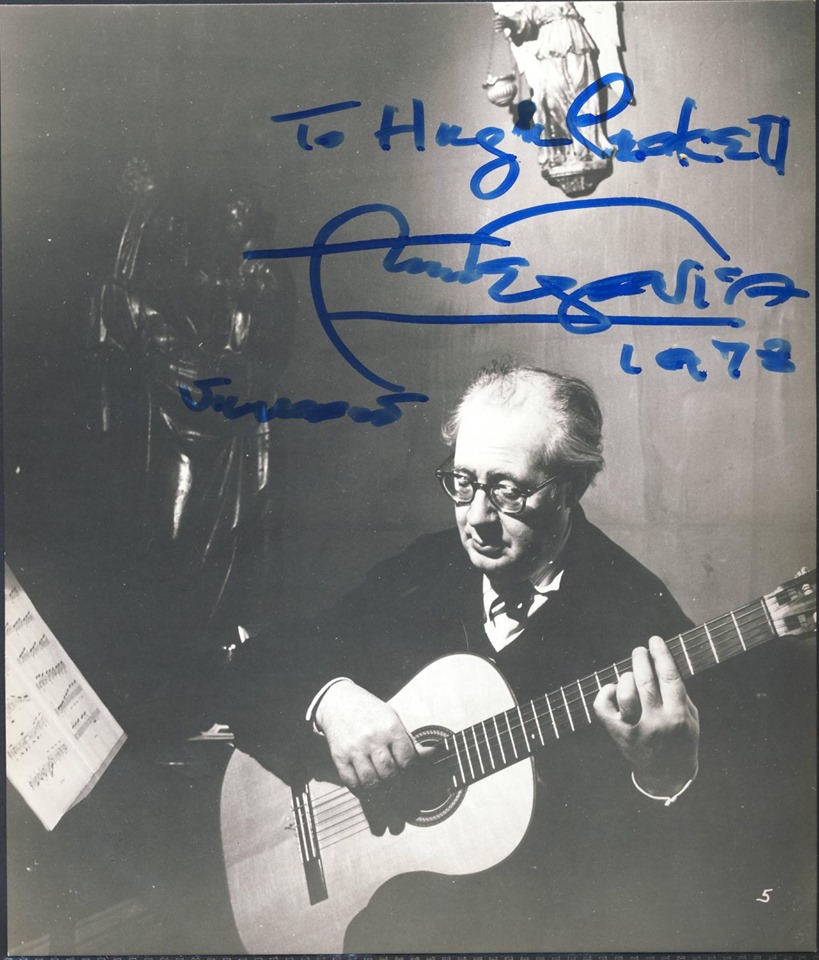
John Saldivar me mandó esta foto en la que aparece Segovia también con esta guitarra; foto firmada y dedicada a alguien por el mismo maestro en el año 1978. La foto también se puede ver en el museo.
John Saldivar sent me this picture in wich Segovia appears with this guitar; signed photo and dedicated to someone by the same Master in 1978. The photo also can be seen in the museum.
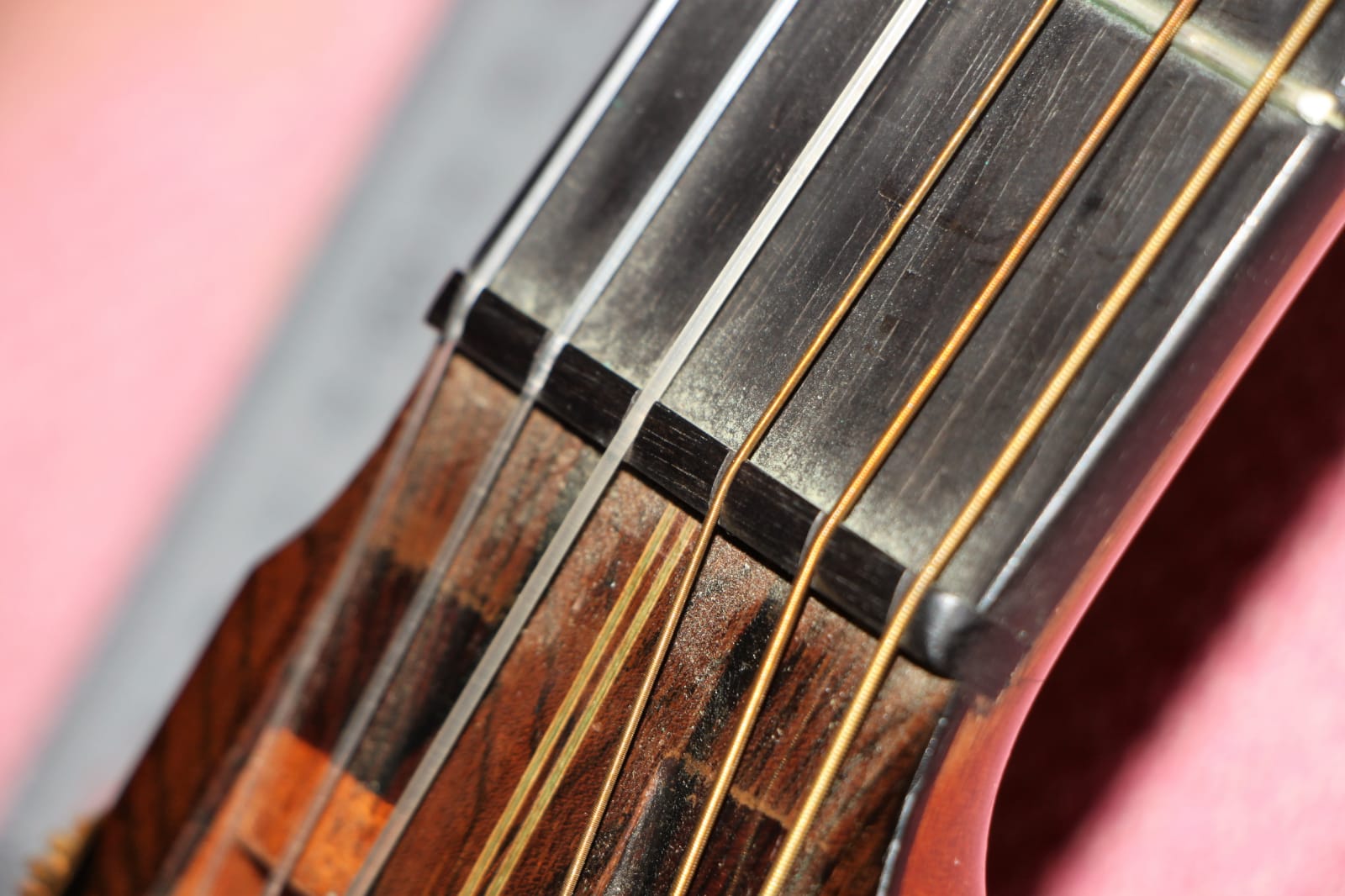
Foto de la guitarra del museo de Linares donde se puede apreciar la cejuela de color negro, en las fotos que ya he mostrado más arriba de Segovia practicando, también se aprecia la cejuela negra.
Se pueden ver unas marcas en la cejuela que podrian ser del grano de la madera, en el caso de que fuera de madera de ébano, por ejemplo.
Pero necesito investigar más sobre esto ya que hay dudas.
El informante Andreas Stevens (Experto e investigador en historia de la guitarra y su repertorio, y jefe del departamento de instrumentos de cuerda pulsada en el Clara-Schumann-Musikschule Duesseldorf ) afirma que ha podido probar una pequeña guitarra Hauser del año 1913 de estilo francés, que también tenía el mismo tipo de cejuela negra, y que a él le parece que podría ser madera de ébano muy densa.
Por otra parte John Saldivar nos comenta que es posible que sea ébano pero también existe la posibilidad de que sea un material sintético como plástico o composite (según le informó el propio Richard E. Bruné), como el que solían usar los alemanes o los suizos en las navajas "Victorinox".
Tengo que prestar más atención en mi próxima visita al museo para poder confirmar este detalle y muchos otros.
Above, photo of the guitar of the Linares Museum where one can see the black nut, in the pictures I posted higher of Segovia practicing, he black nut also can be seen.
Thin lines can be seen in the nut that could be the grain of the wood, in case it was ebony wood, for example.
But I need to investigate more about this since there are doubts.
The informant Andreas Stevens ( Expert and researcher in the history of the guitar and its repertoire, and head of the department of plucked instruments in the Clara-Schumann- Musikschule Duesseldorf ) says that he has been able to test a little Hauser French style guitar, from the year 1913, wich also had the same black nut, and it seems to him that it could be made of very dense ebony wood.
On other hand John Saldivar says that it is possible that it is ebony, but it is also possible that it was made of synthetic material such as plastic or composite ( as Richard E. Bruné himself informed ) like what the Germans and Swiss used tu use in the "Victorinox" knifes.
I have to pay more attention on my next visit to the museum, in order to confirm this detail and many others.
Andreas Stevens también nos aporta otro dato interesante sobre esta guitarra, se trata de un artículo que ha encontrado en la revista "Der Gitarrefreund" Nº 1/2 1954, en el que Segovia expresa sus sentimientos con esa guitarra:
"Y en el futuro tocará Segovia solo esta guitarra en homenaje a su amigo alemán ya fallecido. Pues desde esta guitarra, dirá él, se obtiene un sonido especial, como un saludo desde el más allá".
Andreas Stevens also gives us an interesting fact about this guitar, it is an article that he has found in the magazine "Der Gitarrefreund" Nº 1/2 1954, in wich Segovia expresses his feelings with this guitar:
"And in the future Segovia will only play this guitar in homage to his deceased German friend. Since from this guitar, he says, you get a special sound, as a greeting from beyond".
También quiero mencionar a dos personas que me acompañaron en este día:
Uno es mi amigo y antiguo alumno Joaquín Escobar, que vino desde Sevilla expresamente para ayudarme con la investigación, ya que él además de hacer guitarras, es un amante del arte y de su historia.
La otra persona es Federico Vilaseca, otro amante de las guitarras que reside en Linares y junto con su mujer Manuela tuvieron el detalle de llevarnos a comer a una taberna taurina "El Lagartijo" con mucha solera, nos sentimos como en casa junto a ellos!
I also want to mention two people that accompanied me this day:
One is my friend and former student Joaquín Escobar, who came expressly from Sevilla to help me with the investigation, since apart from making guitars he is also an art lover and his history.
The other person is Federico Vilaseca, another guitar lover who lives in Linares, and together with his wife had the detail of taking us to lunch at a bullfighting tavern "El Lagartijo" with a lot of tradition, we felt at home!
 |
| My former student Joaquín Escobar examining the Hauser guitar |
 |
| With my friend Federico Vilaseca in the Bullfighting tavern |
Por ahora dejamos aquí este artículo sobre la investigación de la guitarra Hauser 1950, pronto tengo intención de volver a Linares para completarla (con permiso de el director del museo), aunque es posible que tenga que hacer más visitas a este museo.
Cada vez que voy a Linares siento que algo me atrae y me invita a volver, ¿será el museo?, ¿será la huella de Andrés Segovia? no sé, siento que algo importante me queda por descubrir allí.
Saludos amigos, os mantendré informados.
For now I leave here this article about the research of the Hauser guitar 1950, but I want to go back soon to Linares to complete it (with permision of the museum director), although I may have to make more visits to this museum.
Every time I go to Linares I feel something attracts me and invites me to return, will it be the museum? will it be the footprint of Andrés Segovia? I dont know, I feel that something important remains for me to discover there.
Regards friends, I will keep you posted.


